AI-Assisted Voice of the Customer Research: Turning Online Conversations into Smarter Utility Campaigns
How AI-assisted analysis of public conversations is reshaping utility program marketing and outreach
Understanding your audience and stakeholders is foundational in today’s energy landscape. Utilities and program administrators rely on surveys, focus groups, and participation data—but these methods often capture structured feedback after the fact and from limited audiences.
At the same time, customers are having real-time, unfiltered conversations across public forums, community platforms, and regulatory channels. AI-assisted tools make it possible to analyze these conversations at scale, helping organizations understand not just what people say, but how they interpret their experiences.
What Is AI-Assisted Voice of the Customer Research?
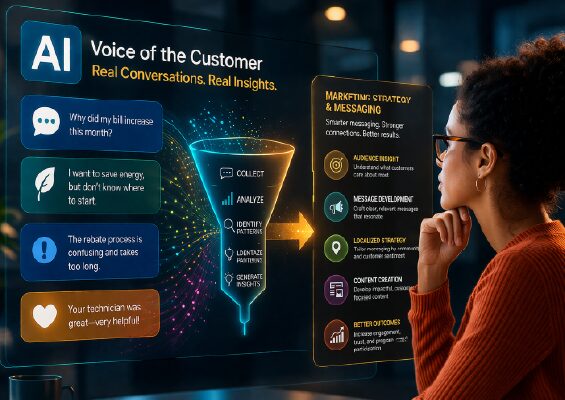
AI-assisted voice of the customer (VoC) research uses artificial intelligence to analyze large volumes of public, unstructured customer conversations—such as online forums, community discussions, and complaint records—to identify patterns in sentiment, language, and behavior. It helps utilities and program implementers understand not just what customers and stakeholders say, but how they interpret their experiences.
What AI-Assisted VoC Research Really Means
AI-assisted VoC research uses natural language processing and pattern recognition to analyze large volumes of public, unstructured conversations. The opportunity is clear: listen where people are already speaking.
This includes sources such as:
- Online forums and neighborhood discussions
- Public comment records and complaint databases
- Local news and community response
- Customer-generated content across digital platforms
Instead of relying only on what customers say in response to a survey, this approach captures what they say when no one is prompting them.
That distinction matters.
Unprompted feedback tends to be more emotional, more specific, and more reflective of real-world experiences. It reveals not just what customers think but how they interpret what’s happening.
And in energy, perception often drives behavior as much as reality.
From Data to Insight: Identifying What Actually Drives Sentiment
One of the most valuable aspects of this approach is the ability to move beyond general sentiment into specific, repeatable patterns.
AI-assisted analysis can quickly surface:
- Common phrases customers use to describe their experience
- Recurring points of confusion or frustration
- Emotional drivers such as anxiety, distrust, or uncertainty
- Misconceptions that shape how people interpret bills, programs, or services
These patterns are not abstract, they are highly practical.
They help answer questions that traditional research often struggles with:
- What are customers actually reacting to?
- What do they believe is happening and why?
- Where does confusion turn into frustration?
For utilities and program implementers, this level of clarity is increasingly important.
Because customers aren’t just evaluating services, they’re forming opinions in real time, often influenced by what they see others saying in their community.
The Shift to Hyperlocal Understanding
Not all customer experiences, or perceptions, are the same.
One of the most powerful capabilities of AI-assisted VoC analysis is the ability to identify localized sentiment patterns.
Conversations vary by:
- Geography
- Housing type
- Income levels
- Community dynamics
This means sentiment is not just a brand-level issue. It’s often a neighborhood-level reality.
AI tools make it possible to:
- Detect where conversation volume is highest
- Identify communities with more intense sentiment
- Understand how local context shapes customer experience
This shift is critical.
Broad, one-size-fits-all messaging often misses the mark because it doesn’t reflect what people are experiencing in their specific environment.
Localized insight allows utilities to meet audiences where they are with messaging that feels relevant, not generic.
Turning Insight into Strategy & Messaging
Insight alone doesn’t change outcomes. What matters is how it’s applied.
The most effective campaigns use AI-informed VoC insights to reshape both strategy and creative execution.
Start With Customer Questions, Not Program Features
Customers rarely start with, “What programs are available?”
They start with questions like:
- Why did my bill change?
- What am I actually paying for?
- Is something wrong—or is this normal?
Campaigns that perform well don’t lead with program details. They start by answering the questions customers are already asking. For example, utilities can use this analysis to identify why customers misunderstand billing changes or avoid participation in energy efficiency programs.
This approach builds immediate relevance and reduces friction.
Use Customer Language, Not Internal Language
AI-assisted research surfaces the exact words and phrases customers use.
This is more than a copywriting improvement, it’s a strategic advantage.
When messaging reflects real customer language:
- It feels more credible
- It’s easier to understand
- It reduces perceived complexity
Our utility and program implementer clients are discovering that clarity isn’t just about simplifying language, it’s about aligning with how people already think and speak.
Address Emotion, Not Just Information
Many energy communications focus on explaining how things work.
But customer reactions are often driven by emotion first, then logic.
AI-assisted VoC analysis helps identify emotional drivers such as:
- Frustration from unexpected costs
- Anxiety around affordability
- Distrust of unclear charges or processes
Effective messaging acknowledges these emotions and responds to them directly.
This doesn’t mean being overly reassuring or promotional. It means being transparent, practical, and helpful.
Design for Clarity & Action
When insights are applied effectively, they influence not just what you say but how you structure the experience.
This includes:
- Clear, diagnostic-style messaging
- Step-by-step explanations
- Visual tools that simplify complex information
- Direct pathways to relevant programs or support
The goal isn’t just awareness. It’s understanding and ultimately, action.
Why This Approach Is Becoming the New Standard
Traditional methods capture feedback after the fact. AI-assisted VoC research isn’t replacing traditional research methods, it’s strengthening them.
Surveys and customer data still provide essential validation and measurement.
But AI-driven analysis fills a critical gap.
It provides:
- Real-time insight into customer perception
- Access to nonparticipant voices
- Context for why satisfaction data may not tell the full story
This combination creates a more complete picture and leads to clearer messaging, higher engagement, and improved program participation.
And as customer expectations continue to evolve, this level of understanding is becoming the new standard for effective communication.
A More Human Approach, Powered by Better Insight
At its core, this approach isn’t about technology, it’s about listening more effectively.
AI simply makes it possible to do that at a scale and depth that wasn’t practical before.
When utilities and program implementers understand not just what customers are experiencing, but how they interpret those experiences, communication becomes more than messaging.
It becomes a tool for clarity, trust, and engagement.
And that’s where the real impact happens.
Bringing It All Together
The most effective campaigns today are not just data-informed, they are insight-driven.
They connect:
- Real customer language
- Localized context
- Clear, practical messaging
This approach helps organizations move from broad awareness to meaningful engagement.
From explanation to understanding.
And from communication to action.
At Equinox Creative, we help our utility and program implementer clients identify complex customer and stakeholder insights and convert them into clear, engaging strategies that resonate at the community level.
Let’s talk about how to turn ideas into strategic marketing insights, with clear, engaging, and effective messaging. Learn more about our Creative Campaigns for program marketing.
Let’s Make Your Campaign Stand Out
Ready to turn your ideas into action? Let’s create a creative marketing campaign together that captures attention and delivers real results.